Scene and user
Confirm in-pipe tasks and exclusions for large tunnels, underground water networks, drainage and utility corridors.
DESIGN FOR RECOVERY
Every rib, opening, interface and material choice must answer: what it protects, how it is made, how it is repaired, how it is verified. The centre is R&D, prototype, review and course at once.
INDUSTRIAL DESIGN
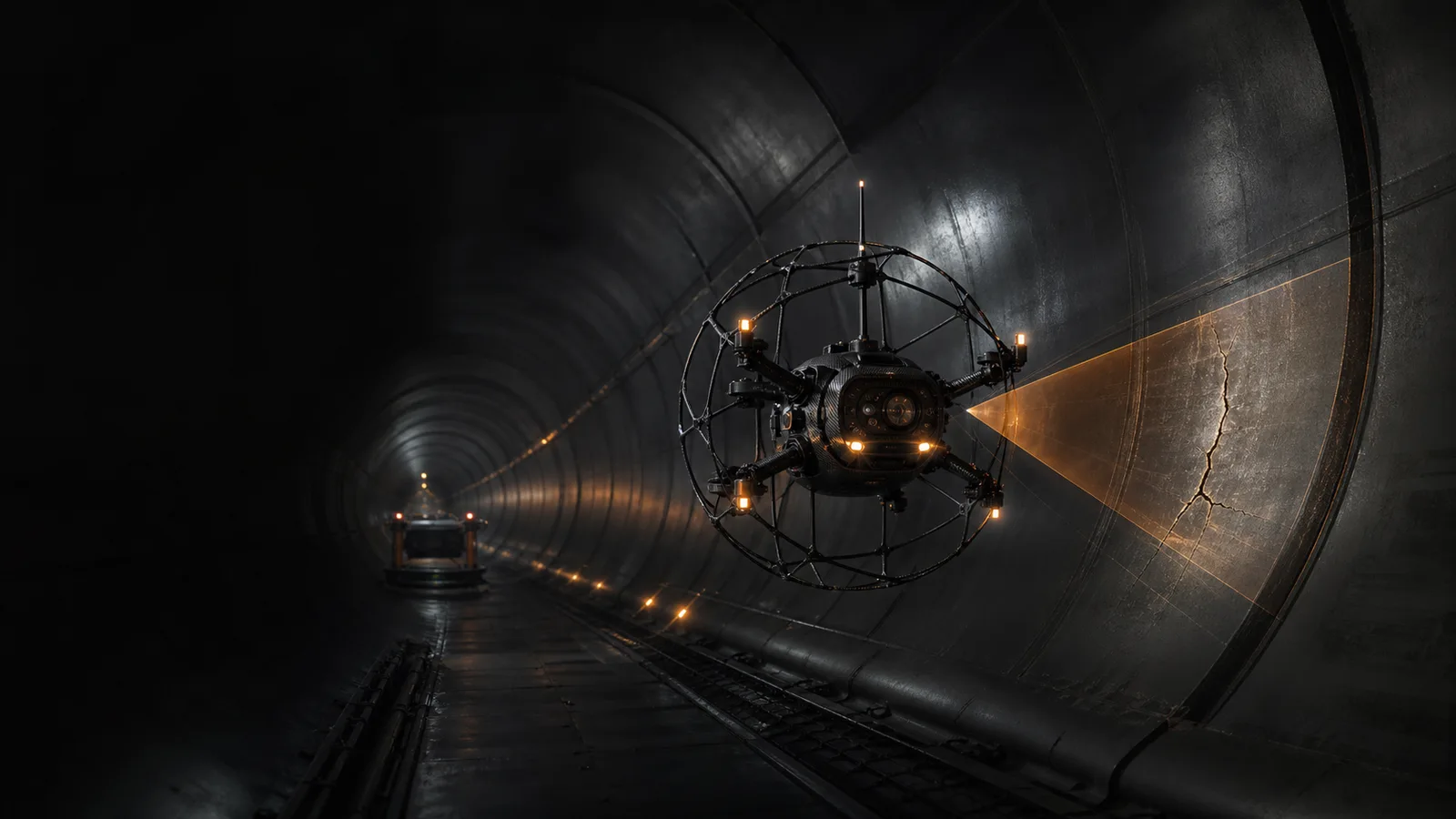
The spherical cage says collision-tolerant, roll recovery, no sharp edges, recoverable. The central payload bay groups low-light / night vision, thermal, depth and dedicated gas sensing. PG-X payload bays reserve fire-suppressant and insulation-tape interfaces; they are not a verified capability today.
In a confined network the first mechanical problem is recovery. Looks come second. Sharp edges snag cables and sediment. A cage that cannot be swapped writes off the whole vehicle after one hit. If ribs block the view, the best algorithm can only label “cannot see”. Design inputs therefore start from failure modes: jam, unknown attitude after a roll, one-person well-head carry, disinfectant compatibility, battery impact.
External products set candidate ranges. S300 spherical protection and modular sensing, THS-04 ducted omnidirectional protection, Elios-class collision tolerance, Scout 137 tethered recovery — all are study objects. Their public numbers are not PipeGuardian measured specs. A P1 target freezes only after scene measurement, mass/power budget and repeated tests.
DESIGN LOGIC
The research → options → selection → form evolution → CAD → scene-expression method is reused from the source PDF. No RailGuard parameter is inherited.
Confirm in-pipe tasks and exclusions for large tunnels, underground water networks, drainage and utility corridors.
Spherical protection expresses collision tolerance, roll recovery, no sharp edges, rotor isolation and recovery.
Freeze rotor keep-out, centre of gravity, battery, sensing, lighting, gas sampling and payload interfaces first.
Night vision, thermal, depth and gas sensing must not occlude each other. Control heat, reflection, mist and wake.
Gloved operation, poke-yoke orientation, module quick-release, well-head grab, decontamination and fault marks.
Dark grey / black for soil; orange marks hazards, grab points and service contacts. Final brand and VI freeze later.
Write split lines, wall thickness, draft, tolerance, fasteners, assembly order, gauges and supply chain into the design.
P0 envelope → P1 engineering prototype → P2 small batch. Each round updates form and interfaces from test results.
DESIGN STATUS
Stage labels serve the site, slides, manuals and filings. Without matching evidence, the status does not upgrade.
| Stage | Current | Outputs on hand | Next gate |
|---|---|---|---|
| S0 | Direction set | Spherical cage, multimodal sensing, well-head recovery, modular payload | Scene and exclusion confirmation |
| S1 | Architecture in progress | System block, module bounds, first envelope | ICD, mass/power/CG budget |
| S2 | Unfrozen | Needs CAD, structure/aero/thermal/seal, CMF, DFMEA | PDR / CDR |
| S3 | Unverified | No citable engineering-prototype performance | P0/P1 plus collision / in-pipe / recovery tests |
| S4 | Not started | DFM, certification, trial and production still open | G5/G6 customer and compliance evidence |
BENCHMARK → DESIGN INPUT
External products set candidate ranges and test questions. They do not mean PipeGuardian has reached the same performance. Freeze only after scene measurement, mass/power budget and repeated tests.
| Dimension | Public sample | PipeGuardian P1 candidate | Gate before freeze |
|---|---|---|---|
| Protection and envelope | S300: 360° spherical cage; THS-04: ducted quadrotor, media max size 450 mm | Replaceable spherical / near-spherical cage; target max envelope ≤400 mm, rechecked against entry and minimum turn | 10 directions × 3 speeds collision, roll recovery, rotor clearance, real well-head and bend passage |
| Endurance and payload | S300 official hover 15 min; THS-04 media ≥25 min useful, 1 kg payload | Standard-payload mission target ≥18 min; reduced-load stretch ≥25 min; standard payload 0.25–0.5 kg; 1 kg is a separate heavy-lift evaluation | Ten mission statistics with full lighting, compute and sensing — empty hover does not substitute |
| Localisation and wall-follow | S300: LiDAR/SLAM, 20–300 cm standoff; THS-04 centimetre localisation is company/media language | 905 nm Class 1 LiDAR candidate, ≥200k pts/s baseline; 0.2–3 m wall-hold as its own control mode | Drift, degradation alarm and takeover in long-straight, wet-wall, dust/mist and repeating texture |
| Low light and thermal | S300: 4K low-light, ~10,000 lm, 256×192 thermal | 4K / f≤1.8 visible, adjustable flux and 256×192-class thermal as a selection baseline | Power/thermal/reflection/motion-blur blind tests; thermal judges temperature difference only, not gas |
| Gas and link | S300 optional CO, H₂S, O₂, CH₄ and fibre; THS-04 stresses quick sensor swap | Modular gas bay; dual-band radio/relay primary, fibre or tether as weak-link backup | Cal gas, fixed reference, wash/flow, response time; drag, turns, loss of link and recovery |
Sources: user-supplied S300 display page · Aerofuture S300 product page · CRSC low-altitude THS-04 introduction · user-supplied Cover News / Toutiao report
EIGHT STAGES
Envelope, mass, airflow, field of view, interfaces and failure modes come before styling. Rigs find problems before a real site does.
Diameter, bends, medium, entry, recovery, disinfection, regulation and stop conditions.
Watch well-head handling, carry, battery swap, wash-down, jams and how existing kit fails.
Compare spherical cage, ring cage, ducts, crawl-fly hybrids and tethered schemes. Record why options die.
Rhino/Grasshopper for space and surfaces; SolidWorks/Creo/Fusion for parametric assembly, ICD, mass and power tables.
Collision load, modes, wall effect, wake, heat, battery isolation, single-point failures and safety margin.
From envelope piece to engineering prototype to small batch: BOM, drawings, tolerances, assembly and inspection.
Static, dynamic, environmental and mission-level tests. Simulation must correlate with measurement, not pretty clouds.
Design, test and production reviews. Every change records root cause, affected parts, verification and a signature.
MECHANICAL CORE
Course work maps onto real subsystems. Results enter the configuration library.
Load path, energy absorb, elastic return, rotor clearance, fatigue, sacrificial parts, stiffness/mass. The sphere turns a collision from a structural accident into recoverable contact.
Motor-prop match, thrust-to-weight, re-ingestion, wall effect, heat and endurance margin. In-pipe power cannot be replaced by outdoor hover data.
Low-light / night vision, fill light, thermal, depth windows; sampling, calibration, response and cross-sensitivity for methane / CO / H₂S / VOC.
BMS, isolation, quick-release, reverse-polarity protection, connector life, harness strain and power cut. Battery safety after impact is part of recovery.
Condensation, drainage, O-rings, disinfectant compatibility, corrosion, flame retardance and finish. First edition does not promise a fully flooded sewer, but must leave design margin for condensate and splash.
Tether points, well-head guidance, gloved operation, carry, decontamination, status lights and service doors. A robot that cannot be recovered is a new confined-space hazard.
16 WEEKS · 96 HOURS
Graduation is a CDR pack, a P1 prototype and a repeatable test. Assessment weights engineering evidence over renders.
| Stage | Block | Topics | Deliverable |
|---|---|---|---|
| W1–2 | Mission and system | Confined space, risk, requirements, interfaces, mass/power budget | Scene cards, system block |
| W3–4 | Mechanics, materials, process | Impact, fatigue, safety factor, plastics / composites / aluminium / elastomers | Cage hand-calc, material matrix |
| W5–7 | CAD, industrial design, tolerance | Parametric assembly, NURBS, product semantics, CMF, human factors, GD&T | Three forms, skeleton model, interface drawings |
| W8–10 | Mechanisms, power, sensing, heat, seal | Quick-release, lock, thrust-to-weight, wall effect, night-vision/thermal/gas layout, condensate, IP method | Mechanism samples, sensing/environment test plan |
| W11–13 | DFM, FEA, FMEA | BOM, suppliers, simulation correlation, failure and risk | Cost, DFMEA, rig |
| W14–16 | Prototype, review, delivery | DAQ, DOE, PDR/CDR/TRR, configuration and assembly | P1 prototype, CDR pack |
FAILURE MODES AS DESIGN INPUT
A form review that cannot name the matching failure should not pass. These failures come from confined-network work, not aerial-photo aesthetics.
Sharp edges, proud screws and open props catch cables, rebar ends and sediment. A spherical / near-spherical envelope, countersunk fasteners and a sacrificial outer layer turn snag into contact you can back out of.
Collision tolerance means a roll is allowed. Flight control and mechanics must show which face is forward, grab points and attitude lights, or recovery crew lose orientation at the well-head.
Ribs, fill-light glare and gas sample tubes hide each other. Perception layout is a mechanical problem. Any new protection needs a new occlusion map. Do not “cage first, cut holes later”.
Gloves, wet footing, poor light. If quick-release needs a tiny mark to be read, the field uses force. Poke-yoke, colour coding and one-hand grab beat saving two grams.
Disinfectant, grease and sewage attack elastomers and coatings. First edition stays out of a flooded pipe, but must list allowed cleaners and banned solvents, or the first demo ruins the O-ring.
Thermal runaway in a confined space is a second accident. Isolation, monitoring and “do not charge after impact” belong in the recovery procedure, with an inspection window in the structure.
P0 / P1 / P2
Envelope piece, engineering prototype and small batch are not the same object under three names. Mixing them distorts supply chain, tests and public photographs.
P0 proves space: rotor clearance, a coarse CG, well-head passage, a human grab. Wood, 3D print and ballast are allowed. A P0 photo may explain semantics. It must not sit next to “collision verification complete”. P1 introduces a replaceable cage, a real battery path, sensing windows and repeatable collision. P1’s job is a failure list, not a film. P2 talks split lines, tolerances, gauges and a second source. Without P1 raw logs, P2 only makes an unverified structure look more like a product.
Shenzhen engineering shows its value in that split. P0 can finish in any lab. P1 tool changes, finish and connector life need suppliers who can visit. P2 BOM freeze needs inspection records, not a spoken lead time. Hong Kong keeps the test plan and evidence writing so engineering speed does not run away with the right to claim. If both sides try to book the same prototype invoice into different subsidy files, the configuration library will fight the filing ledger.
Materials upgrade by gate as well. Round one compares glass-filled nylon, elastomer over-mould, aluminium skeleton and local carbon fibre on impact, repair, decontamination and flame retardance — not a density contest. Sacrificial parts must be identifiable, stocked and replaceable inside a ten-minute target. Fastener orientation is poke-yoke so a left part cannot go on the right at the well-head. Cable strain relief and connector locks must confirm with one hand. Until CDR those sentences are design requirements, not test conclusions that already happened.
Aero and heat cannot rest on outdoor hover data. Near-wall pipe flow changes thrust and recirculation. Full lighting plus compute plus a gas pump is a different thermal load from empty hover. Endurance targets therefore count under a defined “standard-payload mission”. The spec page may keep writing “target” until that statistic exists; it may not delete the word. The mechanical centre can veto any request to put empty-hover numbers into public materials.
TEST FIXTURES
A collision story without a rig outsources risk to the first owner willing to open a hatch. The centre must own repeatable test furniture first.
Minimum rig list: multi-direction drop or pendulum; replaceable pipe sections (straight, elbow, reducer); controllable illuminance and mist; cal-gas ports; a recovery rail or well-head mock; synchronised cameras and IMU. Each test writes hypothesis, primary metric and fail criterion in advance. A test that cannot count repetitions cannot upgrade S3.
Rigs also serve the course. If a graduate piece cannot be reproduced on the same fixture, the documentation failed. Visitors may see the rig. A visit is not certification. Certification belongs to G6 laboratories and the site owner.
Relation to the eight design steps: interference, heat and service problems found on the rig must flow back into CAD. A render must not hide interference. Change records write root cause, affected parts, verification and a signature, or the configuration library collapses in week two. The centre exists so that loop is daily work, not a post-accident patch.
CONFIGURATION CONTROL
Swapping the wrong cage version in a confined space can kill rotor clearance and field of view together. The configuration library is a product of the centre, equal to the parts.
Every replaceable module needs a drawing number, material lot, mass, interface version, test status and a forbidden-pairing table. Field kits carry released combinations only. Software version and mechanical version must record each other, because flight-control filtering may depend on a specific inertia. Scrap is marked and isolated so “it still flies” does not become oral tradition.
A second source is investigation only before P2, not a promise. Dual-sourcing too early copies unfrozen tolerances twice. Inspection templates are written now: dimension, torque, insulation, cell origin. Those files later serve G6 and the no-double-funding cost ledger.
Industrial-design orange marks hazards, grab points and service contacts only. Final brand VI remains unfrozen. Dark grey / black is a working colour, not a registered trademark expression. The mechanical centre refuses drawings that treat the concept-model image as a production render.